

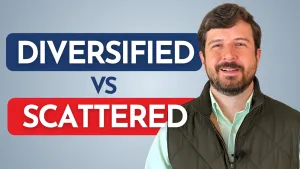
Diversified vs Scattered Investments: What Pre-Retirees Need to Know
If you’re heading into retirement, you’re likely thinking about how your investments are positioned for this next chapter. But here’s a question that many pre-retirees haven’t considered: are your investments diversified or just scattered?
There’s a big difference between these two approaches, and one could seriously impact your retirement plans in ways you might not expect.
What Does True Investment Diversification Mean?
Being diversified means your investments are thoughtfully spread across different types of assets, industries, and markets, all working together toward your financial goals.
The Intentional Nature of Diversification
Diversification is intentional. It’s designed to help manage risk, create stability, and provide confidence no matter what the market throws your way. True diversification involves strategic allocation across:
- Asset classes (stocks, bonds, real estate, commodities)
- Geographic markets (domestic and international exposure)
- Industry sectors (technology, healthcare, financials, consumer goods)
- Market capitalizations (large-cap, mid-cap, small-cap companies)
- Investment styles (growth and value approaches)
Professional Coordination in Diversification
Effective diversification needs ongoing coordination and rebalancing to maintain your target allocations as market conditions change and your retirement approaches. This isn’t a “set it and forget it” strategy – it needs regular attention and adjustment.
What Makes Investments “Scattered” Rather Than Diversified?
Scattered investments tell a different story. Scattered means your investments are spread across different accounts, possibly with different advisors or left behind in previous employers’ retirement plans, with no clear strategy connecting them.
The Common Scattered Investment Pattern
It’s easy to mistake scattered holdings for diversification, but this arrangement can become a recipe for confusion, overlooked risks, and missed opportunities.
I’ve witnessed this scenario repeatedly: a client approaches retirement with accumulated investments that look diverse on the surface but lack any coordinated strategy.
Real-World Example of Scattered Investments
Consider someone with:
- A 401(k) at their current employer
- Two previous employer 401(k) accounts they never rolled over
- A Roth IRA opened years ago with different asset allocation
- A taxable brokerage account with yet another investment approach
- Some individual stocks purchased based on various recommendations
While this appears to be diversified, these accounts can work against each other rather than in harmony.
Why Do Scattered Investments Create Problems?
The Clarity Problem
When investments are scattered, it’s hard to know how much risk you’re taking across all accounts combined, how your investments are performing as a whole, or whether you’re on track to meet your retirement goals.
Estate Planning Complications
Not to mention critical questions about beneficiaries – who are they on each account? How do those accounts factor into your estate plan? Could your heirs even locate all the accounts if something happened to you?
Overlapping and Conflicting Strategies
Scattered accounts often result in:
- Duplicate holdings across multiple accounts
- Conflicting investment strategies that may negatively impact each other
- Inappropriate risk levels when viewed holistically
- Tax inefficiency from poor account coordination
- Higher overall fees from multiple account maintenance
How Does Consolidation With Purpose Work?
That’s why consolidation with purpose is important for pre-retirees. This approach involves organizing your investments and aligning them with your goals to gain clarity, control, and hopefully peace of mind.
Strategic Account Organization
Consolidation doesn’t necessarily mean putting everything in one place – it means creating a coordinated strategy across all your accounts that works together efficiently.
We work with clients to evaluate:
- Which accounts should remain separate for tax or legal reasons
- Which accounts benefit from consolidation for better management
- How to coordinate asset allocation across all remaining accounts
- Tax implications of any consolidation moves
Creating a Cohesive Retirement Plan
Instead of a scattered mess, you develop a cohesive plan designed around your lifestyle in retirement and your legacy planning goals.
This coordinated approach typically results in:
- Clearer risk management across your entire portfolio
- Better tax efficiency through strategic account usage
- Simplified monitoring and rebalancing processes
- Improved estate planning coordination
What Should Pre-Retirees Evaluate About Their Current Investments?
If you’re unsure whether your investments are diversified or just scattered, several key questions can help guide your assessment.
Investment Coordination Questions
Do you know your overall asset allocation? Can you quickly determine what percentage of your total investments are in stocks versus bonds versus other assets?
Are your accounts working together? Do the investment choices in each account complement each other, or are you inadvertently duplicating or conflicting strategies?
How are you managing risk? When you consider all accounts together, are you taking more or less risk than you intend for your retirement timeline?
Administrative and Estate Planning Considerations
Are beneficiaries current and coordinated? Do all accounts have appropriate, up-to-date beneficiary designations that align with your estate planning goals?
Could your heirs find everything? Do you have a comprehensive list of all accounts and their locations that someone else could access if needed?
Are you paying unnecessary fees? Are there opportunities to reduce costs through consolidation or better account coordination?
When Should You Seek Professional Guidance for Investment Organization?
This evaluation and coordination process often benefits from professional guidance, particularly as you approach retirement when the stakes for getting it right become higher.
The Complexity of Pre-Retirement Investment Management
Pre-retirement investment management involves multiple considerations that interact in complex ways: tax planning, estate planning, risk management, income planning, and legacy goals.
Professional Assessment and Implementation
We work with clients to assess what they currently have, identify gaps in their strategy, and build a coordinated approach that fits their specific retirement goals and timeline.
This process typically involves:
- Comprehensive account inventory and performance analysis
- Risk assessment across all holdings
- Tax efficiency evaluation and optimization opportunities
- Estate planning coordination and beneficiary updates
- Income strategy development for retirement years
What Are the Long-Term Benefits of Organized Investment Management?
The difference between scattered and strategically diversified investments becomes more significant as you move through retirement.
Improved Decision-Making Capability
With organized, coordinated investments, you can make informed decisions about withdrawals, rebalancing, and strategy adjustments based on complete information rather than partial account views.
Enhanced Legacy Planning
Coordinated investment management can make estate planning more effective and reduce complications for your heirs when they eventually need to manage or inherit these assets.
Greater Retirement Confidence
Perhaps most importantly, having a clear, coordinated investment strategy can provide peace of mind during retirement – you understand what you own, why you own it, and how it supports your retirement lifestyle and goals.
Frequently Asked Questions About Investment Diversification vs Scattering
Should I consolidate all my retirement accounts?
Not necessarily. Some accounts should remain separate for tax or legal reasons, but they should still be coordinated as part of an overall strategy. Professional analysis can determine an appropriate structure for your situation.
How often should I review my investment coordination?
Pre-retirees should review their complete investment picture at least annually, with more frequent monitoring during the actual retirement transition period when circumstances change rapidly.
What’s the biggest mistake people make with scattered investments?
Assuming they’re diversified when they’re actually taking unintended risks or missing opportunities due to lack of coordination across accounts.
How do I know if my current level of diversification is appropriate?
This requires analyzing your complete investment picture against your risk tolerance, time horizon, income needs, and legacy goals – considerations that usually benefit from professional assessment.
What happens to scattered investments if I become incapacitated?
This is one of the biggest risks of scattered investments – if accounts are spread across multiple institutions with different contact information and beneficiary designations, it can create significant complications for family members trying to manage your financial affairs.
Can I fix scattered investments myself?
While some coordination can be done independently, the tax implications, estate planning considerations, and strategic allocation decisions often benefit from professional guidance to avoid costly mistakes.
Moving Forward With Investment Clarity
Clarity about your investment strategy is just a conversation away. Whether your investments are currently diversified or scattered, there are steps you can take to improve coordination and confidence as you approach retirement.
The goal isn’t perfection – it’s creating a clear, coordinated strategy that you understand and that works effectively toward your retirement and legacy goals.
We help pre-retirees assess their complete investment picture, identify opportunities for improvement, and build strategies designed around their specific retirement lifestyle and legacy objectives.
Your retirement security depends not just on how much you’ve saved, but on how well your investments work together to support your goals throughout retirement and beyond.
Let’s talk about your next step.
Investment advisory services are offered through CapSouth Partners, Inc, dba CapSouth Wealth Management, an independent registered Investment Advisory firm. Information provided by sources deemed to be reliable. CapSouth does not guarantee the accuracy or completeness of the information. This material has been prepared for planning purposes only and is not intended as specific tax or legal advice. CapSouth does not offer tax, accounting or legal advice. Please consult your tax or legal advisor to discuss your specific situation before making any decisions that may have tax or legal consequences.